As a journalist have you ever wondered what questions should be asked?
Late last year during a community dinner organized by the University of Alabama I shared a table with AL.com reporter Ben Flanagan and musician Jake Gordin. The purpose of this dinner was to discuss ways to revitalize downtown Tuscaloosa. But during the meal I, a journalism student at the University of Alabama, also received a lesson in good reporting.
Flanagan, who had interviewed Gordin about his band Electric Moon in the past, had all of the right questions for Gordin and his music
So, what exactly do artists and musicians want to be asked?
“You get straight to the pertinent questions,” Gordon said to Flanagan. “You don’t want to hear annoying questions. People don’t really care about who my musical inspirations were.”
Sometimes we may fall guilty to asking a question just to make sure that we have enough to ask. Just because we have enough questions, it does not mean that we are asking the right questions. As an interviewer, if the question does not really spark your curiosity, why ask it? If you are about to interview a musician, there may be a little curiosity about who they grew up listening to, but if it is not pertinent to the subject of the interview, it should be avoided.
To some, that sounds simple enough; avoid pointless questions and get straight to the point. The person being interviewed, however, should also be as engaged in the interview as you are.
“An interviewer’s first and only priority should be the subject,” Flanagan said. “In an artist’s case, they put their souls into their work, and if you think it’s worth sharing with your community and readers, you owe them the very same effort in finding what drives someone to reach that emotional and artistic expression.”
If a musician has an upcoming show it would be appropriate to ask about the show, but a creative mind is always thinking of something new. Although questions about their concert are important, consider their future plans, too. What’s next for them? From an artist’s standpoint, they are excited to promote themselves and tell the world about their latest creation. Give them a chance to shine.
A person is giving their time for the interview; the least we as journalists could do is prepare for it.
Research is critical when preparing for an interview. Researching before the interview saves the journalist time and it might even spark questions that you never considered asking.
Not only does it give you more fuel for an interview, it might also answer some of your questions. Many people might get exasperated with answering the same questions, so carefully consider what is to be asked.
After all, you never want to be the journalist who frustrated your subject to their breaking point during an interview.
Ariel Worthy, a Birmingham native, is a junior at the University of Alabama. When not in class writing, she can be found writing her own short stories, reading poetry, cooking, looking up natural hair blogs or watching The Big Bang Theory and Boardwalk Empire. Follow her on twitter @airreeulll.
]]>
A few days ago Beyonce turned the world of music, the land of social media and the lives of her fans upside down when she released a surprise album. As a die-hard Bey fan myself, I spent Friday caught between disbelief and elation and couldn’t wait to get home from my day job so I could immerse myself her eponymous fifth studio album.
Coming out of what was supposed to be a month-long hiatus from my personal blog, this weekend I wrote about what Beyonce’s album means to me as a feminist. But I’ve been thinking about what it means to me as a writer too.
When it comes to typical music marketing strategies, Beyonce broke all the rules. And it worked. Just as Mrs. Carter is doing things on her own terms, I want to see more women writers doing things on their own terms too and doing so successfully. Ladies, let’s not wait around to be picked as if we’re a lonely wallflower at the school dance. It’s time to make our move and get on the floor.
Here are five things I think we women writers can learn from Beyonce’s surprise album release:
Be brilliant. Beyonce’s new release could have been a simple 10-track mixtape and it still would have garnered plenty of attention. But you don’t become the Queen (or the King) through mediocrity. Beyonce’s new album is a cohesive body of work that includes 14 tracks and 17 videos. Who does that?! She does. And you should follow suit. This is especially important for women writers looking to self-publish. Allow me to be frank: There’s a reason self-publishing has been looked down upon for so long. Too often self-published books are of sub-par quality — in desperate need of an editor and a decent cover design. Self-publishing should not be seen as a last resort after your work has been turned down by other publishing houses. Self-publishing should be the route you take when you want more creative control. And whether you’re self-publishing or not, you should always present your very best work.
Be bold. Beyonce’s new album is unlike anything we’ve seen from her and this surprise release is unlike anything we’ve seen before in music. Women writers, don’t be afraid to try something new. That crazy idea you have for a book or blog just might work. That wild story idea you have for your favorite magazine just might be the pitch the editors have been waiting for.
Be tireless. Beyonce didn’t need months or weeks of marketing to promote her new album. Instead she just hit the stage or as she says in the song “Ghost,” — “I don’t trust these record labels/I’m tourin.'” The hard work she puts into her shows was all the promotion she needed. And be honest, can you think of a performer who works harder on stage? Now it’s your turn. What’s the hard work you need to do to set the stage for your success as a writer? Do you need to write every day so you can finish that book? Do you need to pitch publications every week so you can make a name for yourself in magazines? Do you need to launch a book or blog tour of your own? Guest blog for other websites. Be active on social media. Seek out speaking engagements. Build your brand.
Be transparent. Beyonce’s fans love this album, I think, for the same reason we love her documentary Life Is But a Dream and her website Beyonce.com — it gives a glimpse into the life of Queen Bey. We enjoy seeing beyond Beyonce the brand and getting a peek at Beyonce the person. Believe it or not, your readers want the same from you. Don’t pretend you have it all together. Don’t pretend to have all the answers. Be vulnerable in your writing. Be willing to show your scars so others can learn how to heal.
Be a Queen Bee. Beyonce affectionately calls her fans the BeyHive and when this album dropped you better believe we were buzzing. In fact, Beyonce’s surprise album release even surpassed Sharknado in social media buzz. Women writers, we must be the Queen Bee and build beehives of our own. We each need a group of loyal readers — people who are more than followers, but fans. Jeff Goins calls this building a tribe. Regardless of your name for this process, it’s one that must be done. But do so sincerely and selflessly. Focus on building up your readers, not yourself. Consider what can you add to their lives with your writing. Consider how you can make their lives better with your wisdom and skills. You can build your beehive through a blog or even by starting a networking group like See Jane Write Birmingham. Uplift your fans and they will uplift you.
]]>
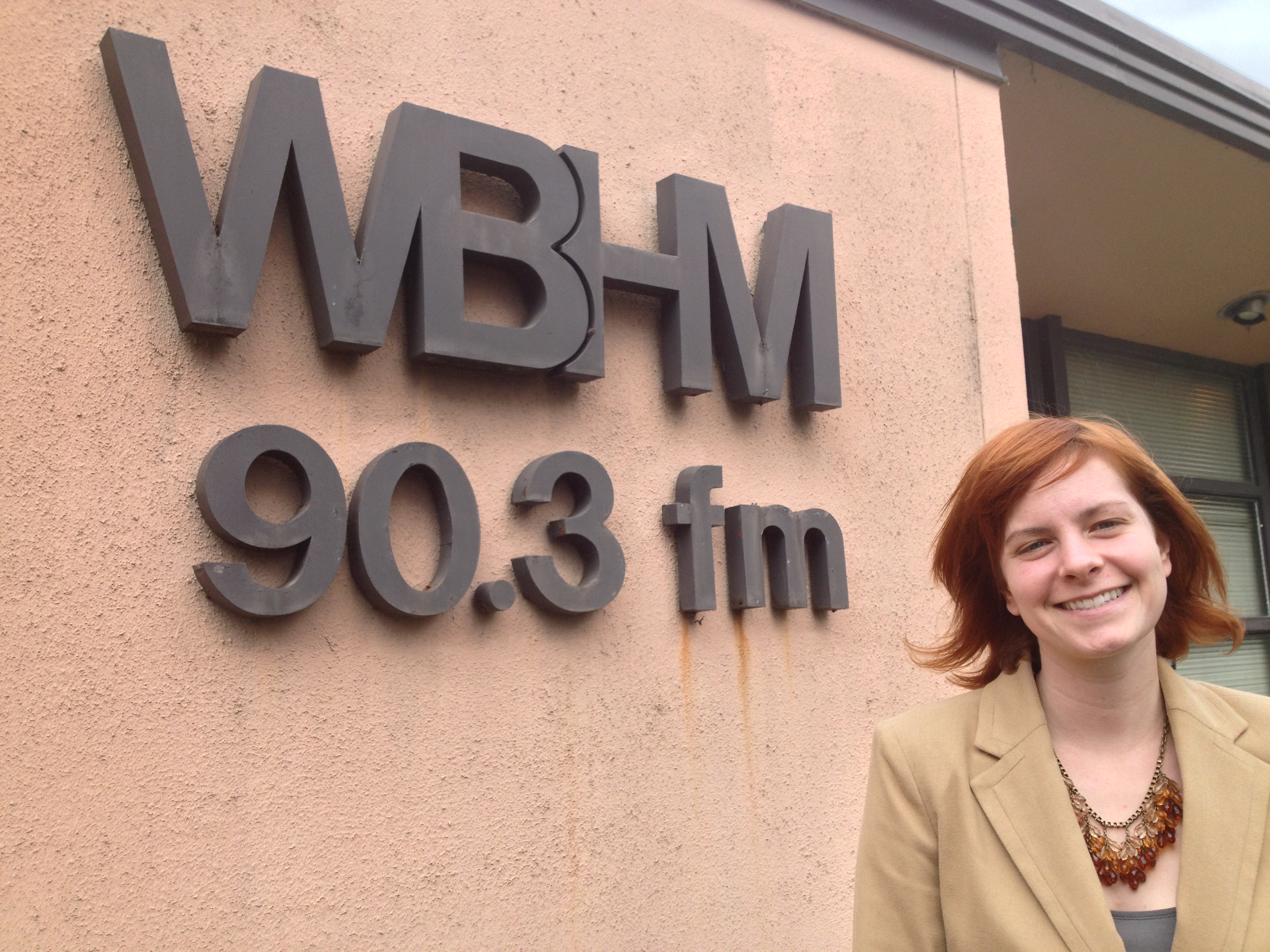
“Birmingham is a bright and energetic community full of stories worth telling,” says Rachel Osier Lindley, and as the news director for Birmingham’s NPR news station WBHM 90.3 FM Lindley is determined to help share those stories. “I want to work with my colleagues and fellow community members to harness that energy — and turn it into great radio.”
Lindley became WBHM’s news director in September and has big plans for Birmingham. She wants to increase the station’s news staff and produce more in-depth original reporting on topics like education, race, economic development and health. She’s also interested in pursuing more collaborative projects with other media organizations in the city. And Lindley wants to expand the station’s website to include a variety of voices.
Prior to coming to WBHM, Lindley worked for Marfa Public Radio, a network of smaller stations in West Texas.
“We regularly worked with local writers, community organizations, and non-profits to produce a wide variety of original programming,” Lindley explains. “Since we didn’t have a large staff, we had to collaborate with other people and organizations. Collaboration wasn’t a choice, it was a necessity, it was just how we did things. I plan to encourage that mindset here at WBHM, and work with more community partners.”
For Lindley a love for storytelling seems to be in her blood. “Growing up, everyone in my family wrote,” she says. Her father made educational films for Encyclopedia Britannica and was a horror story writer and illustrator in his spare time. Her mother studied journalism briefly before going into nursing, but even after going into the medical field she often wrote articles for nursing publications and local papers.
“Writing was something I just thought all adults did,” Lindley says. “Because of that influence, I’ve done creative writing for fun all my life.”
Lindley’s interest in radio grew from a love of music. Her father was a huge fan of jazz and so was she.
“I grew up just outside of Chicago, and we had a great public jazz station that a community college operated. I spent hours listening to that station,” Lindley recalls.
“I also spent a big chunk of my childhood making fake radio shows on my boom box – recording stories, reading made-up news broadcasts with my friends, creating radio plays. I loved collecting those moments with my friends and being able to listen to them again later.”
Eventually Lindley’s imaginary radio show would become a real one.
“Lucky for me, my high school had a great broadcast program,” Lindley says. “We had a TV studio, a cable access TV channel, and a radio station that played over the campus loudspeakers before and after school. I had a radio show before class each day called ‘Rock and Roll High School,’ and hosted a talk show on the TV station.”
Lindley went on to study journalism at the University of Texas at Austin.
“My first item of business after arriving on campus was to apply for a radio show at KVRX, the student radio station,” Lindley says. “I was a DJ there all 4 years of school, and was the station’s Programming Director for most of that time.”
Lindley also interned at Austin’s public radio station KUT.
“Interning at KUT during college was what made me want to work in public radio,” Lindley says. “Interviewing and reporting for radio was a perfect combination of many of the things I was interested in. I decided that’s what I wanted to do.”
Lindley believes that any students interested in public radio should make it a priority to land an internship. She also offered advice that could be valuable to journalists and writers of any age: “Work hard. Challenge yourself and get our of your comfort zone as much as possible. Don’t be afraid to ask questions. Find other women who are smarter and more accomplished than you and learn from them.”
You can meet Rachel Osier Lindley and other members of the WBHM staff at Issues & Ales:Leadership. The event will be held Tuesday, Nov. 19 from 5:30 to 8 p.m. at WorkPlay, 500 23rd St. South. Representatives from throughout Birmingham will discuss the challenges with leadership, civic engagement and regional cooperation that North Central Alabama faces. Lindley will help facilitate the discussion. RSVP here.
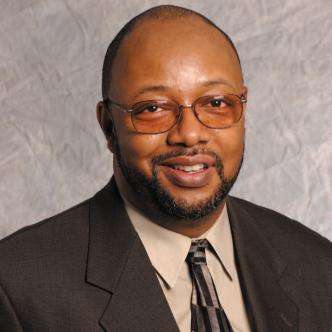
As a student journalist at the University of Alabama, whenever I hear an accomplished journalist speak to an audience, the same question burns in my mind each time: What do I have to do to get to your success? Leonard Pitts Jr., a Pulitzer Prize winning writer with Miami Herald, recently spoke to students and others at the University of Alabama. Pitts offered sage advice that all journalists should take along with them on their path to success.
“Read, then write.”
The best way to learn about writing is to examine how others do it. Skills and inspiration won’t come from a two-hour seminar. The inspiration that comes from studying the work of other journalists will give you the courage to write in the style that you have developed.
“Writing well requires persistence.”
The ability to write well does not have a shortcut. There is no copy and paste when it comes to writing. You must be willing to put in the time. Understand that writing is rewriting.
“Most pieces that you read of mine, I’ve read them 20, 21 times,” Pitts said.
Develop patience so you will take the time necessary to read and rewrite your work.
“Good enough is not good enough,” Pitts said.
“Spell check is a stupid tool.”
You must be your own editor when it comes to your work. Remember, spell check does not know the difference between “their” and “there.”
Don’t be afraid to be a reporter.
During Pitts’ talk, one audience member asked, “Where have all of the journalists gone?” Everyone wants to be a columnist, but not a news reporter, the attendee explained.
“We’ve gotten less into the news business and more into the punditry business,” Pitts said.
Pitts blamed broadcast journalism for this problem. It gives a false narrative in which there is nothing we can agree about.
Report what matters
When watching TV news, how much of it is news that is important for you to know and how much is inspired by stimulating pictures?
“I think about this every time there is a story about someone who loses control of their car and drives into an empty building,” Pitts said.
The security camera catches it, and the news shows the footage several times and then slows it down for you.
“That’s a completely useless story,” Pitts said.
Inform!
Media have a lot to account for in this country, but they must not misinform. Media can also give an inaccurate picture of certain demographic groups.
“People don’t realize that the street crime in this country is down to almost record levels.” Pitts said.
He went on to say that many in the media are more interested in selling a story than giving news. That is what we as journalists have to get back to: reporting real news and being less of a pundit, Pitts said.
Media must not forget our purpose: to give the news and let others form their own opinion.
Ariel Worthy, a Birmingham native, is a junior at the University of Alabama. When not in class writing, she can be found writing her own short stories, reading poetry, cooking, looking up natural hair blogs or watching The Big Bang Theory and Boardwalk Empire. Follow her on twitter @airreeulll.
]]>
I must admit that when I decided to attend University of Alabama’s (insert the name of the panel discussion) I wasn’t too sure what to expect. I was hoping the discussion wouldn’t turn into a debate about whose race is right and whose is wrong.
The University of Alabama was caught with egg on its face when its student paper, The Crimson White, published a story about Greek segregation. UA’s Mallet Assembly organized a march to protest the segregation and the story quickly grabbed national attention. In response to the outcry, the sororities finally integrated and last month four black girls and two other minority girls accepted invitations (or bids) to join historically white sororities.
The Capstone Association of Black Journalists (UA’s chapter of the National Association of Black Journalists) recently hosted a panel discussing the role journalism played in integration. The panel included Catenya McHenry Ashford, who covered the march for Reuters.com, Jamon Smith, a reporter for Tuscaloosa News, Mazie Bryant, The Crimson White’s editor-in-chief and Stephen Dethrage, a reporter for AL.com.
Fortunately, this panel discussion did not turn into a great race debate, but instead offered lessons that I, a student journalist, found quite valuable.
Speak up!
The University has had its share of racist moments and black students and faculty have come out and complained about it, but this time it was white students who spoke out about it.
Smith laments the fact that for years complaints from minority students about segregation within the school’s Greek system were ignore and that change didn’t happen until white students began to speak out.
“Why is it when a white sorority came forward, things got done?” Smith asked.
Nonetheless, Smith is glad that change has come and hopes it’s here to stay. Smith hopes this year’s integration isn’t a temporary fix to get the media off the school’s back.
Bryant sees the story as a lesson in the importance of speaking up.
“Don’t be afraid to question things,” she said. “This story would not have come out if people weren’t willing to talk about it.”
Having a named source is what made this story different from the others. Having an anonymous source can sometimes make a story less credible, so having a girl willing to put her name out there gave the story life.
Be fair.
Bryant, who is a member of a historically white sorority, was commended by the other panelists for removing herself from the story and letting the reporters take the lead. Her job was to be sure the paper was being fair.
“[The CW] had to make sure that everyone was given the opportunity to voice their opinion and defend themselves,” Bryant said.
Have a thick skin.
Regardless of how fair you are, however, when you speak up on an issue – especially one as touchy as race – you can expect backlash.
“We had a lot of offensive comments on AL.com,” Dethrage said.
Bryant received criticism as well.
Many alumni felt the story should be left alone. Dethrage explained how his father, who used to be in a fraternity, thought so.
“There is always going to be someone weighing on what you’re writing about.” Dethrage said.
That’s no reason to stop.
And that is the most important lesson I took away from this talk: As a journalist you have to be willing to go there and when you do, don’t turn back. Keep moving forward.
Ariel Worthy, a Birmingham native, is a junior at the University of Alabama. When not in class writing, she can be found writing her own short stories, reading poetry, cooking, looking up natural hair blogs or watching The Big Bang Theory and Boardwalk Empire. Follow her on twitter @airreeulll.
]]>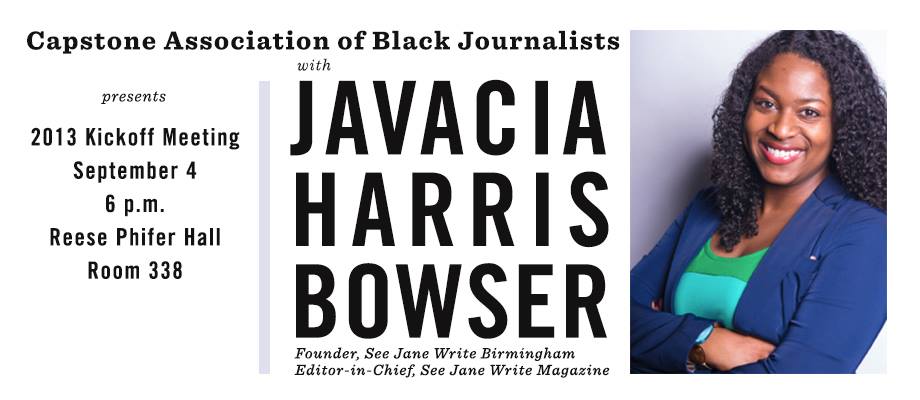
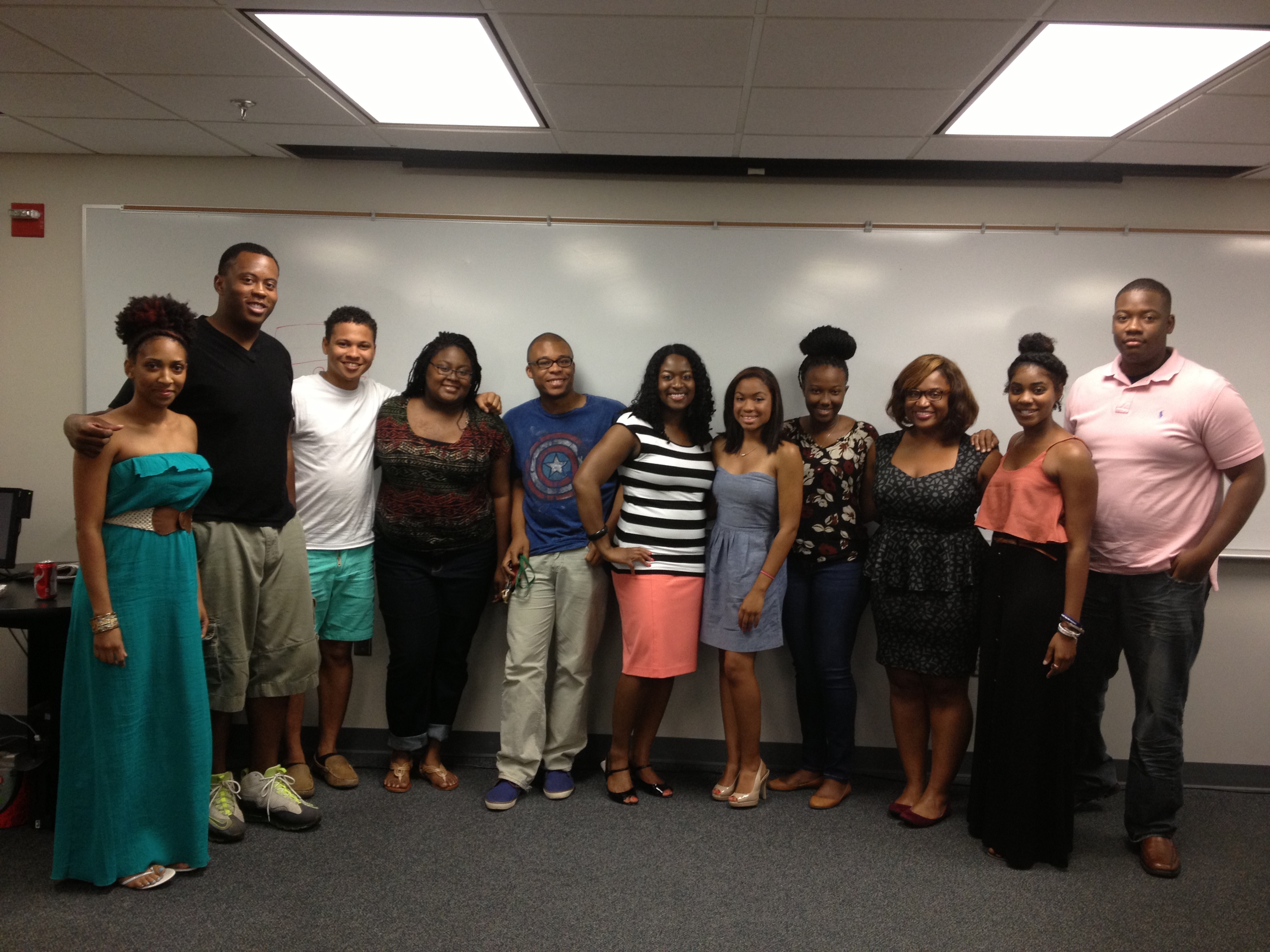
Last week I had the opportunity to return to my alma mater, the University of Alabama, and give a talk to students in the communications department. This event was hosted by the Capstone Association of of Black Journalists (CABJ), UA’s chapter of the National Association of Black Journalists (NABJ). I was honored to speak at this gathering because not only am I a graduate of of Alabama, but I was once president of CABJ.
The CABJ faculty adviser who asked me to address the students asked that I simply share with them three things I wish someone would have told me when I was in college. Believe it or not, that was quite easy for me to do. I know exactly what I wish I could go back and tell my younger self.
“Don’t be afraid to leave home or to go back.”
I grew up in Birmingham and like most folks from Alabama I spent my teen years talking about how I couldn’t wait to leave. And I did. First in short spurts, doing an internship at The Courier-Journal in Louisville, Ky., the summer of 2002 and then returning to Louisville the following summer for an internship with the city’s Associated Press bureau. Then in 2003 I moved to California for grad school. I went to UC Berkeley for my master’s and I spent some time in Seattle doing an internship at The Seattle Times. After I graduated from Berkeley I went back to Louisville to work as a full-time features reporter. (You probably noticed the Louisville theme. Yes, there was a boy involved. Yes, he’s now my husband.)
So I left home, just as I had hoped, but each time I had the opportunity to leave home I was completely terrified – especially when I went to California and to Seattle because I was so far away from home and I knew no one there when I arrived. I found the woman I lived with in Seattle on Craig’s List!
But it’s OK to be scared. In fact, my life’s mantra is a quote by Eleanor Roosevelt who once said: “Do one thing every day that scares you.”
I grew so much as a person and as a writer when I was away from home, so I believe that everyone should be willing to leave home. But I also think that you shouldn’t be afraid to go back.
I moved back to Birmingham in 2009 and I spent my first couple of years back thinking I’d made a huge mistake. But within the past year I have realized that it was one of the best decisions I could have made, which leads me to the next piece of advice I would give my younger self:
“Things may not turn out the way you planned, and that’s OK.”
I spent my teen years not only hoping to leave Birmingham but also dreaming of starting my own magazine.
I wanted to be a media maven.
I had it all planned out. After studying journalism in college I would move to New York and soon get hired at Essence where I’d work my way to the top to become editor-in-chief like my idol Susan L. Taylor. Then, after I’d made my mark, I would start a magazine of my own.
But after grad school my magazine dreams were deferred.
My plans to live in New York faded once I fell in love with and married a man who preferred living in a smaller city. I snagged a features writing gig right out of grad school, but as the print journalism industry began to suffer, as magazines folded and newspapers laid off staff, the idea of starting a magazine became laughable.
As things started to get rough at my paper in Louisville I started looking for a Plan B. When I was in graduate school I taught communications and poetry classes to undergraduate students and absolutely loved it. So I decided I would try teaching full time and I moved back to Birmingham to do that.
Even though I love teaching and I grew to love Birmingham I wondered if I’d made a mistake. I missed writing and Birmingham hardly seemed the ideal place for an aspiring media maven.
But it was in Birmingham that I started See Jane Write Birmingham, a networking organization for local women writers, bloggers and journalists. I doubt an organization such as this one would have been very special in a place like New York, but in Birmingham, the residents embraced my idea. I hosted panel discussions, workshops, and networking events and people showed up!
In Birmingham, I also became fascinated with blogging and building online communities. And then finally it hit me: I could start an online blog-style magazine.
And on July 1, 2013 this website was born.
I am convinced that See Jane Write Magazine could have only come to be in Birmingham, in my hometown.
So that’s why I say one shouldn’t be afraid to leave home or to go back.
“It really is all about who you know.”
People say nice guys finish last, but I say that’s a lie.
See Jane Write – both the organization and the magazine – have been possible because of all the connections I have made since I moved back home. I had to start from scratch because I had never lived in Birmingham as a working adult. But I did and still do some sort of networking daily.
And because of these connections when I have See Jane Write events, people show up. When I needed sponsors for the See Jane Write Magazine launch party, a dozen businesses signed up to help out.
People support me because I’m not a jerk. They help me because while See Jane Write does offer something valuable I work to let people know I value them as well — not just as writers or bloggers or business owners — but as beautiful human beings.
In addition to my teaching job and the work I do with See Jane Write, I also freelance for a number of local and national publications. I even have a regular gig with USA Today. But I didn’t get any of those freelance jobs because the editors were impressed by my fancy Berkeley degree. I got them because of people I met during internships, during my full-time reporting job in Louisville, or through See Jane Write. I got them because I’m not only a good writer, but I’m a good person to work with.
There is no need to step on others on your way up. Be kind. Be yourself.
]]>