I must admit that when I decided to attend University of Alabama’s (insert the name of the panel discussion) I wasn’t too sure what to expect. I was hoping the discussion wouldn’t turn into a debate about whose race is right and whose is wrong.
The University of Alabama was caught with egg on its face when its student paper, The Crimson White, published a story about Greek segregation. UA’s Mallet Assembly organized a march to protest the segregation and the story quickly grabbed national attention. In response to the outcry, the sororities finally integrated and last month four black girls and two other minority girls accepted invitations (or bids) to join historically white sororities.
The Capstone Association of Black Journalists (UA’s chapter of the National Association of Black Journalists) recently hosted a panel discussing the role journalism played in integration. The panel included Catenya McHenry Ashford, who covered the march for Reuters.com, Jamon Smith, a reporter for Tuscaloosa News, Mazie Bryant, The Crimson White’s editor-in-chief and Stephen Dethrage, a reporter for AL.com.
Fortunately, this panel discussion did not turn into a great race debate, but instead offered lessons that I, a student journalist, found quite valuable.
Speak up!
The University has had its share of racist moments and black students and faculty have come out and complained about it, but this time it was white students who spoke out about it.
Smith laments the fact that for years complaints from minority students about segregation within the school’s Greek system were ignore and that change didn’t happen until white students began to speak out.
“Why is it when a white sorority came forward, things got done?” Smith asked.
Nonetheless, Smith is glad that change has come and hopes it’s here to stay. Smith hopes this year’s integration isn’t a temporary fix to get the media off the school’s back.
Bryant sees the story as a lesson in the importance of speaking up.
“Don’t be afraid to question things,” she said. “This story would not have come out if people weren’t willing to talk about it.”
Having a named source is what made this story different from the others. Having an anonymous source can sometimes make a story less credible, so having a girl willing to put her name out there gave the story life.
Be fair.
Bryant, who is a member of a historically white sorority, was commended by the other panelists for removing herself from the story and letting the reporters take the lead. Her job was to be sure the paper was being fair.
“[The CW] had to make sure that everyone was given the opportunity to voice their opinion and defend themselves,” Bryant said.
Have a thick skin.
Regardless of how fair you are, however, when you speak up on an issue – especially one as touchy as race – you can expect backlash.
“We had a lot of offensive comments on AL.com,” Dethrage said.
Bryant received criticism as well.
Many alumni felt the story should be left alone. Dethrage explained how his father, who used to be in a fraternity, thought so.
“There is always going to be someone weighing on what you’re writing about.” Dethrage said.
That’s no reason to stop.
And that is the most important lesson I took away from this talk: As a journalist you have to be willing to go there and when you do, don’t turn back. Keep moving forward.
Ariel Worthy, a Birmingham native, is a junior at the University of Alabama. When not in class writing, she can be found writing her own short stories, reading poetry, cooking, looking up natural hair blogs or watching The Big Bang Theory and Boardwalk Empire. Follow her on twitter @airreeulll.
]]>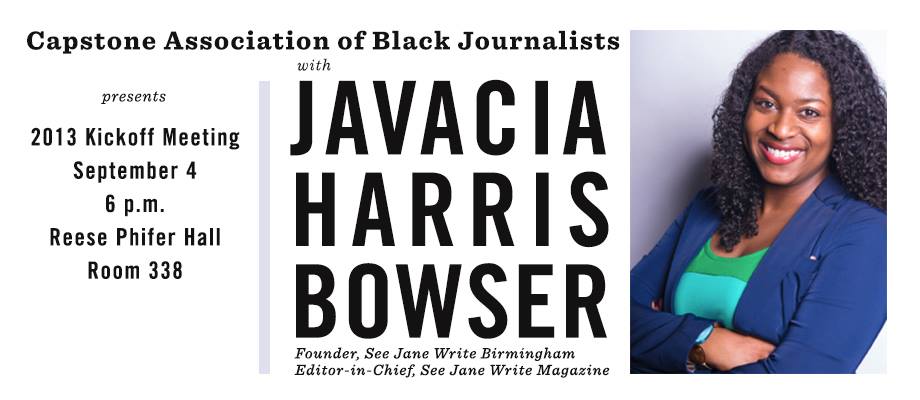
Last week I had the opportunity to return to my alma mater, the University of Alabama, and give a talk to students in the communications department. This event was hosted by the Capstone Association of of Black Journalists (CABJ), UA’s chapter of the National Association of Black Journalists (NABJ). I was honored to speak at this gathering because not only am I a graduate of of Alabama, but I was once president of CABJ.
The CABJ faculty adviser who asked me to address the students asked that I simply share with them three things I wish someone would have told me when I was in college. Believe it or not, that was quite easy for me to do. I know exactly what I wish I could go back and tell my younger self.
“Don’t be afraid to leave home or to go back.”
I grew up in Birmingham and like most folks from Alabama I spent my teen years talking about how I couldn’t wait to leave. And I did. First in short spurts, doing an internship at The Courier-Journal in Louisville, Ky., the summer of 2002 and then returning to Louisville the following summer for an internship with the city’s Associated Press bureau. Then in 2003 I moved to California for grad school. I went to UC Berkeley for my master’s and I spent some time in Seattle doing an internship at The Seattle Times. After I graduated from Berkeley I went back to Louisville to work as a full-time features reporter. (You probably noticed the Louisville theme. Yes, there was a boy involved. Yes, he’s now my husband.)
So I left home, just as I had hoped, but each time I had the opportunity to leave home I was completely terrified – especially when I went to California and to Seattle because I was so far away from home and I knew no one there when I arrived. I found the woman I lived with in Seattle on Craig’s List!
But it’s OK to be scared. In fact, my life’s mantra is a quote by Eleanor Roosevelt who once said: “Do one thing every day that scares you.”
I grew so much as a person and as a writer when I was away from home, so I believe that everyone should be willing to leave home. But I also think that you shouldn’t be afraid to go back.
I moved back to Birmingham in 2009 and I spent my first couple of years back thinking I’d made a huge mistake. But within the past year I have realized that it was one of the best decisions I could have made, which leads me to the next piece of advice I would give my younger self:
“Things may not turn out the way you planned, and that’s OK.”
I spent my teen years not only hoping to leave Birmingham but also dreaming of starting my own magazine.
I wanted to be a media maven.
I had it all planned out. After studying journalism in college I would move to New York and soon get hired at Essence where I’d work my way to the top to become editor-in-chief like my idol Susan L. Taylor. Then, after I’d made my mark, I would start a magazine of my own.
But after grad school my magazine dreams were deferred.
My plans to live in New York faded once I fell in love with and married a man who preferred living in a smaller city. I snagged a features writing gig right out of grad school, but as the print journalism industry began to suffer, as magazines folded and newspapers laid off staff, the idea of starting a magazine became laughable.
As things started to get rough at my paper in Louisville I started looking for a Plan B. When I was in graduate school I taught communications and poetry classes to undergraduate students and absolutely loved it. So I decided I would try teaching full time and I moved back to Birmingham to do that.
Even though I love teaching and I grew to love Birmingham I wondered if I’d made a mistake. I missed writing and Birmingham hardly seemed the ideal place for an aspiring media maven.
But it was in Birmingham that I started See Jane Write Birmingham, a networking organization for local women writers, bloggers and journalists. I doubt an organization such as this one would have been very special in a place like New York, but in Birmingham, the residents embraced my idea. I hosted panel discussions, workshops, and networking events and people showed up!
In Birmingham, I also became fascinated with blogging and building online communities. And then finally it hit me: I could start an online blog-style magazine.
And on July 1, 2013 this website was born.
I am convinced that See Jane Write Magazine could have only come to be in Birmingham, in my hometown.
So that’s why I say one shouldn’t be afraid to leave home or to go back.
“It really is all about who you know.”
People say nice guys finish last, but I say that’s a lie.
See Jane Write – both the organization and the magazine – have been possible because of all the connections I have made since I moved back home. I had to start from scratch because I had never lived in Birmingham as a working adult. But I did and still do some sort of networking daily.
And because of these connections when I have See Jane Write events, people show up. When I needed sponsors for the See Jane Write Magazine launch party, a dozen businesses signed up to help out.
People support me because I’m not a jerk. They help me because while See Jane Write does offer something valuable I work to let people know I value them as well — not just as writers or bloggers or business owners — but as beautiful human beings.
In addition to my teaching job and the work I do with See Jane Write, I also freelance for a number of local and national publications. I even have a regular gig with USA Today. But I didn’t get any of those freelance jobs because the editors were impressed by my fancy Berkeley degree. I got them because of people I met during internships, during my full-time reporting job in Louisville, or through See Jane Write. I got them because I’m not only a good writer, but I’m a good person to work with.
There is no need to step on others on your way up. Be kind. Be yourself.
]]>