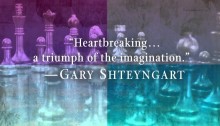
By Mandy Shunnarah
 If you were to ask me the best book I’ve read in the past two years, I could tell you without thinking about it. Yet, as much as I have loved A Partial History of Lost Causes by Jennifer duBois, I’ve actually avoided writing a book review about it. It’s not because I want to keep it to myself, but because I was afraid I wouldn’t be able to adequately articulate just how much I love this book.
Despite listening to a myriad of book podcasts and keeping up with a number of book news websites, I’ve heard nothing of A Partial History of Lost Causes from any sources. I found the novel one day while in Square Books in Oxford, Mississippi. The book wasn’t displayed prominently on a table. It wasn’t featured in the store’s newsletter. It wasn’t chosen as a staff pick. I was walking past a row of shelves and it called to me.
The novel follows Irina Ellison, a thirty-year-old working toward her Ph.D. in Russian literature at Harvard. She fears she has inherited Huntington’s disease, which claimed her father’s life. When her father’s mind was still intact, he admired Alexandr Bezetov, a young Russian chess prodigy who later became world chess champion. When shuffling through some of her father’s papers after his death, Irina finds a copy of a letter written to Bezetov asking him a poignant question—how do you proceed gracefully in a lost cause? This discovery propels Irina to leave everything behind to find Bezetov in Russia. Her father never received an adequate answer, and Irina feels she must retrieve it, for her father and for herself.
A Partial History of Lost Causes is literary fiction of the best kind. While every sentence is crafted into a museum-quality work of art, it’s not off-putting by being intentionally difficult to read in order to uphold the dignity of the literary arts. It reads like a story written by an author who knows she has nothing to prove. And duBois doesn’t—I mean, she recently won a MacArthur Genius Award for pete’s sake…
What drew me into the novel was that without an ounce of magical realism, Irina embarks on an adventure—both literally and of self-discovery—that doesn’t hinge on a romantic relationship. And although her journey doesn’t lead her to a concrete answer for how to proceed gracefully in a lost cause, she learns so much along the way that, as the reader, you hardly notice that she doesn’t technically succeed in her quest. In truth, there are no concrete answers to life’s toughest questions because the answers are different for everyone’s experiences. For this reason, I appreciate that duBois didn’t try to fabricate an answer because it would have ruined the novel with its dishonesty. And, contrary to what the fiction genre implies, it’s heavily rooted in the truth.
Furthermore, because of the circumstances of Irina’s health, she presents herself as cold and standoffish since she fears making human connections knowing she may not be around long enough to see them flourish. Despite her seeming coldness, as a reader and a woman, I readily related to her. Any woman who has ever wanted to do something “drastic” that she knows will give her life meaning and has faced opposition by friends and family as a result will understand the urgency of Irina’s quest and respect the boldness of her will. Irina’s adventure masks another prominent question that A Partial History of Lost Causes asks: What would you do if you knew you only had one year to live? I found that Irina’s journey inspired me to ask myself some tough questions.
Amid the philosophical complexities of the novel, the story is laden with Russian history and politics. However, duBois is careful not to overwhelm the reader with extraneous details—each detail presented moves the story forward. duBois minces no words and wastes no sentence. As you read, you’ll likely find yourself underlining captivating phrases. Even with as many books as I consume, duBois strung words together in a way that rendered me in awe of the beauty of the English language.
For more information on Jennifer duBois and A Partial History of Lost Causes, check out duBois’ author page and learn more on Goodreads.
Mandy Shunnarah is a freelance writer and editor, and an aspiring novelist. When she’s not writing, she can be found reading, learning to letterpress, watching Downton Abbey and Game of Thrones, and finding stray cats to cuddle with. Follow her on Twitter at@fixedbaroque and @awhitewrites.
Thanks for every other great post. The place else may just anyone get that kind of info in such a perfect method
of writing? I’ve a presentation subsequent week, and I am on the look
for such information.