
Three years ago when Keith Lee was in his last year of law school the job market was bleak for young lawyers. Lee knew he needed to do something to make himself stand out. So he started a blog.
Lee’s blog Associate’s Mind soon became one of the most popular law blogs around and eventually landed him a book deal with the American Bar Association.
Lee’s first book, The Marble and the Sculptor, was released last week and is shaping up to be the fastest selling book the ABA has published.
Despite the success of his blog and debut book, Lee says, “I still have trouble thinking of myself as a writer.”
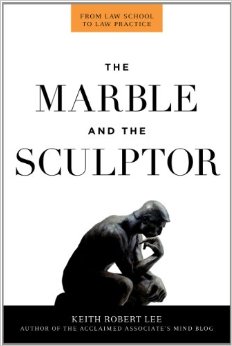
The Marble and the Sculptor is intended to be a manual for young lawyers but has life advice that could be useful to anyone in any career. The book’s title is from a quote by the controversial Nobel Prize-winning surgeon and biologist Alexis Carrel: “Man cannot remake himself without suffering, for he is both the marble and the sculptor.”
And this title speaks to the essence of the book: self-transformation. Lee, who works at Hamer Law Group in Birmingham, Ala., told The Birmingham News: “That quote describes the transitions I made in life to grow. It’s not so much adding to my life, it’s what I’m cutting away from it that matters.”
Just as Lee’s book can be useful to people who aren’t lawyers, his blogging journey has lessons for bloggers of any niche.
While working on his book, Lee continued to blog regularly, practice law, spend time with his wife and son, and attend networking events around Birmingham.
“Sleep is for the weak,” Lee says with a laugh, adding that he doesn’t watch much TV. He does, however, make time to exercise regularly as it gives him the energy he needs to be efficient and productive.
Though Lee still struggles to see himself as a writer, he’s accomplished what many writers dream of doing: landing book deals through their blogs.
When the ABA conducted a survey asking their young lawyers division where they turn for industry news, Lee’s Associate’s Mind blog was one of the top three websites these young attorneys listed. And so when the ABA wanted to publish a book for emerging lawyers, they knew Lee was just the person they needed.
Lee says he built his following largely through online networking. He stresses the importance of commenting on other blogs. Find other bloggers in your niche and become a part of their communities, he says.
Instead of depending on social media, Lee says, “Email is king.” When he was growing his blog Lee would often share, via email, interesting and important information with popular law bloggers. To show appreciation, those bloggers would then mention Lee in the posts related to the information he passed along. And after Lee built relationships with these established bloggers they were also willing to promote Lee’s site more directly.
This type of marketing takes time, Lee says, but it works.
“It’s about providing value to other people,” he says.
Keith Lee’s book launch party for The Marble and The Sculptor will be held Nov. 14 starting at 5:30 p.m. at Aloft Hotel, 1903 29th Ave S. in Homewood. The event is free and open to the public.
]]>
Blogging has given so many people the opportunity to have their voices heard. But Attorney Keith Lee of Hamer Law Group, and author of the blog Associate’s Mind, reminds us bloggers that with this opportunity come responsibilities and liabilities. Take some time to familiarize yourself with laws relevant to blogging and make sure you are complying with them.
Lee offers three laws bloggers should know:
You have the right to free speech. The government has no right to censor or impede you sharing your opinions. It is unlikely you will ever face any restrictions on your speech from the government. But sometimes individuals or businesses will attempt to suppress an individuals right to free speech through what is known as a SLAPP – Strategic Lawsuit Against Public Participation. Let’s say a blogger decides to write about a bad experience at a restaurant. The owner then reads the review and decides to sue for defamation. The restaurant files a lawsuit against the blogger as a way to threaten and bully them to take the review down. The restaurant is betting on the fact that they have deeper pockets, and better lawyers, than a small-time blogger. Despite the restaurant’s attempt to intimidate the blogger, the lawsuit likely would fail if it ran its course.
You are not responsible for the speech of others on your website. Comments are fantastic to receive on your blog because it indicates that your readers are engaged with your writing. But it can also be a headache it they are negative or attacking people in public. But as a blogger you are generally protected. Specifically, you are protected by a section of the Communications Decency Act passed in 1996. While much of the Act has been struck down as restrictions on free speech, one important part has survived: Section 230 says that “No provider or user of an interactive computer service shall be treated as the publisher or speaker of any information provided by another information content provider” (47 U.S.C. § 230). Under the law, bloggers are not liable for comments left by readers, the work of guest bloggers, tips sent via email, or information received through RSS feeds. Section 230 provides the protection that has allowed innovation and freedom to thrive on the Internet.
You are required to disclose endorsements and affiliate links. Many people who start blogs do so in the hopes of them becoming a business. The way many bloggers make money is through the endorsement of products and services through affiliate links, which direct a visitor to a sales page and credits the host-blog with a commission should the visitor make a purchase by tracking the link back to them. This type of activity went unfettered for many years before the government stepped in. In 2009 the Federal Trade Commission revised its rules and regulations regarding endorsements and testimonials in reaction to blogs and online advertising. What these new rules mean is that there is now a requirement for voluntary disclosure of endorsements and affiliate links.
The easiest way to do this is a simple statement: “This is an affiliate link,” or “I received this product from X company – but I am endorsing it because I use it and believe in it.” What matters here is honest communication with the reader, not compliance with some obscure legalese.
*This article was adapted from a guest post previously written by Keith Lee for the See Jane Write blog.
Hamer Law Group, LLC specializes in non-profit and business formation. If you’re thinking of starting a company visit the See Jane Write blog for 5 Steps to Consider When Starting a New Business.
]]>