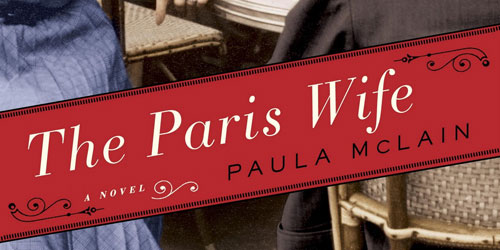
Maybe it’s just me, but in my recent trips to bookstores, I’ve noticed an inordinate amount of “wife” titles in the fiction section. The Aviator’s Wife, The Paris Wife, The Time Traveler’s Wife, The Senator’s Wife, Ahab’s Wife, The Shoemaker’s Wife… and a Goodreads search of “wife” will yield many more.
My initial reaction was to slap my forehead in frustration at the sheer number of fictitious tales of women defined in opposition to their husbands, rather than the exploration of their personal identities. My frustration mounted with the realization that nearly all the authors were women. I’ve read enough feminist blogs and articles on the Huffington Post’s Women’s section to know that women who are also wives and/or mothers can feel they lack personal identity, especially when being called “so-and-so’s mom” or “so-and-so’s wife.” I felt there could be no other explanation for the wife fiction phenomena than female authors caving in to social pressures to subvert women’s wills or imply women lack intrinsic value in absence of a husband.
Like any good frustrated feminist bookworm, I did some research. I started reading “wife” books. But I was pleasantly surprised at what I found.
The female protagonists in the books weren’t at all what I expected. They weren’t lacking personal identity. Rather, their fierce individualism shone in spite of society relegating them to the strict, gendered role of wife. It’s well documented that, all too often, women have been written out of history, and these fictitious accounts allow readers to empathize with the woman, thereby giving her a voice.
For example, The Paris Wife follows Hadley Richardson, Ernest Hemingway’s first wife, during the time they lived in Paris in the 1920s before Ernest had really made a voice for himself. In the end, Ernest leaves Hadley for another woman (this is said on the book jacket, so it isn’t a spoiler). Being a famous writer, I doubt he was harshly chastised for this (celebrities still get off with a mere slap on the hand), yet the book illustrates what that must have felt like for Hadley.
Likewise, I read that Ahab’s Wife was conjured from a passing mention of Ahab’s wife in Moby Dick. I realize that Hadley Richardson was indeed a real person and Ahab’s wife Una was fictitious, but Ahab’s Wife still provides an important rendering of womanhood in nineteenth century America.
It seems that, counterintuitively and contrary to my initial reaction, these fictitious accounts from the wives’ point of view are showing the value of the female experience and fighting against the sexist biases of historic accounts. The eras may be past, but my hope is that these novels will make readers think of them more broadly. You know what they say, better late than never.
Mandy Shunnarah is a freelance writer and editor, and an aspiring novelist. When she’s not writing, she can be found reading, learning to letterpress, watching Downton Abbey and Game of Thrones, and finding stray cats to cuddle with. Follow her on Twitter at@fixedbaroque and @awhitewrites.
]]>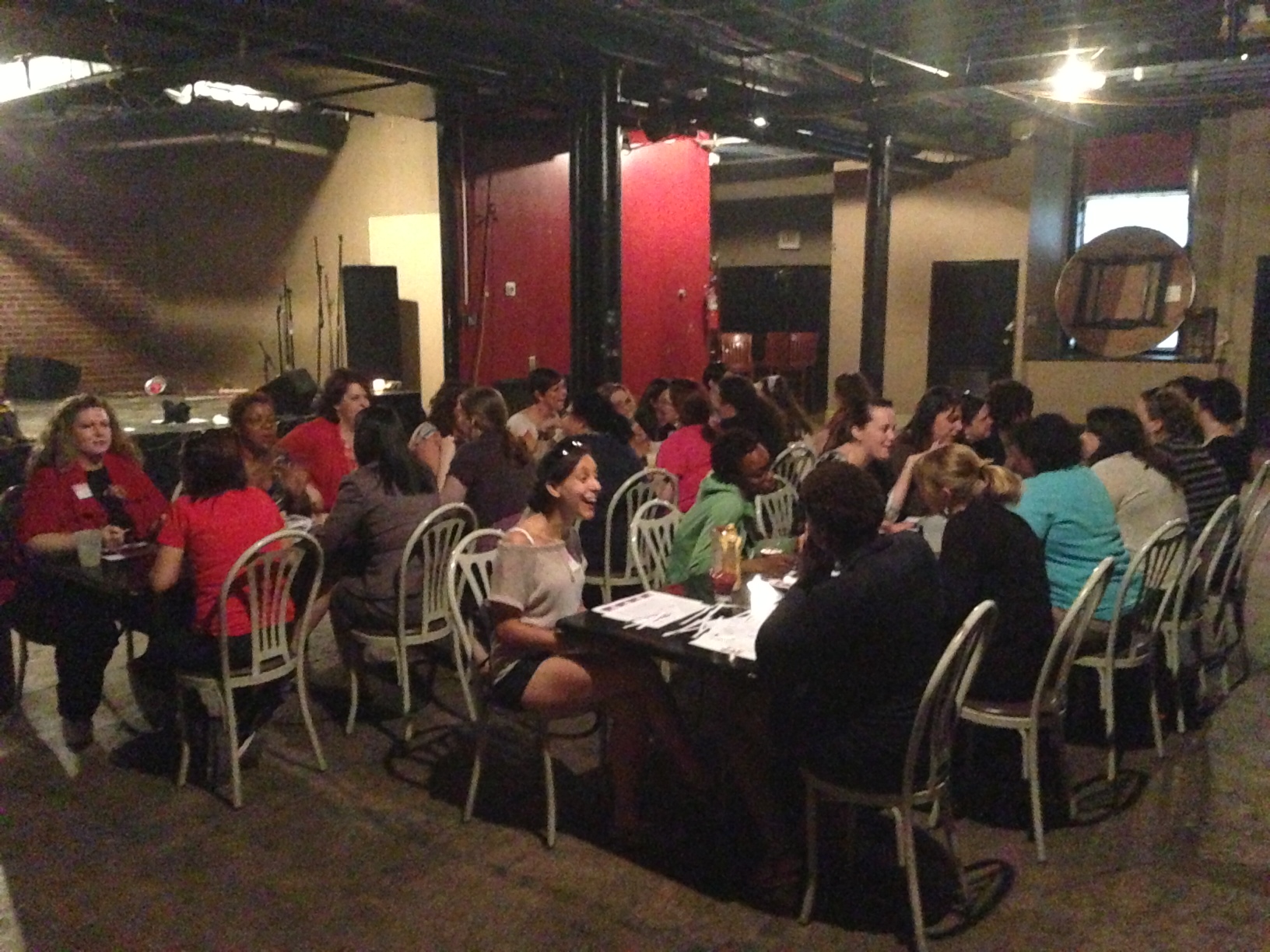
We called them Girl Power Pow Wows. Sherri Ross Walters and I would meet with some of our best gal pals at a Birmingham-area restaurant and chat about our goals and personal projects.
During one of these meetings Sherri shared an idea she had to start an organization for women, an organization meant to help women achieve lofty aspirations like the ones we had been sharing with one another over black bean burgers and fries.
The Birmingham Girls Club was born.
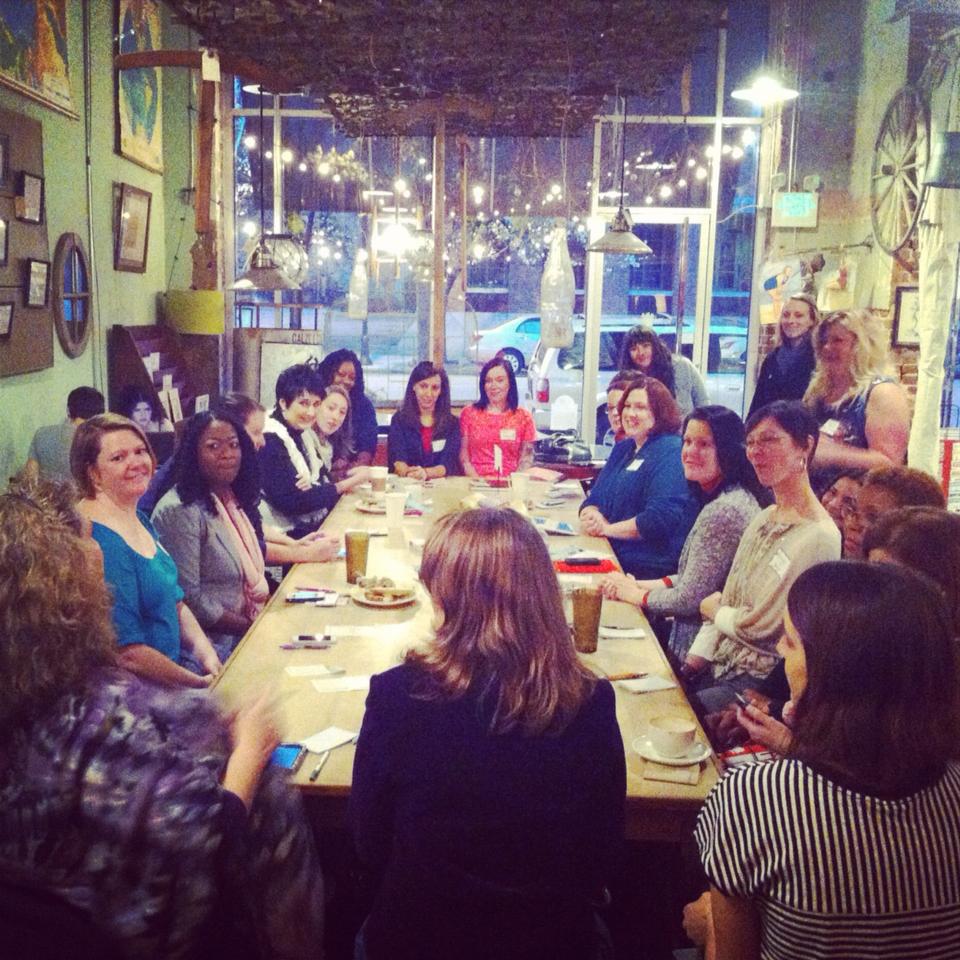
“The club was started as a safe haven of sisterhood for women to share their ideas and get help if needed,” Sherri says. “I hope the members form amazing new friendships, connections, and get what they need from the club. That will be different for each woman. I can see relationships starting already and women are getting together privately outside of the club. They are getting what they need from each other and that’s exactly what the club is about.”
The Birmingham Girls Club officially launched in May 2013 after a casual informational meetup earlier in the spring. The club hosts monthly socials and regular philanthropic events. For example, in September the group volunteered at the Magic City AIDS Walk.
“Birmingham Girls Club was created to network, but also grow our minds, bodies, and souls while also giving back to the community, to help round out all aspects and grow the best of Birmingham,” Sherri says.
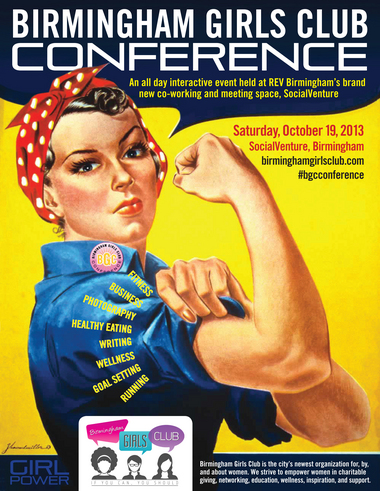
On October 19 Sherri will host the first Birmingham Girls Club Conference.
“I wanted a chance to showcase our members and their talents, and also give the public a chance to see what we are about and how they can get involved,” Sherri says of the conference, set to be held at REV Birmingham’s Social Venture. “We wanted to put on a day of fun that was atypical of normal conference tracks. We are trying hard to keep this informative and interactive – no projectors and slideshows.”
Instead, Sherri says, attendees can expect sessions that “reflect exactly what the Birmingham Girls Club stands for — growing your mind, body, and soul. We will have creative tracks like photography and art, intellectual tracks like goal setting and personal branding, physical tracks like running and stress-management exercises, and growing tracks like telling your story and healthy eating.”
Sherri wants the women who attend the conference to feel comfortable being themselves and letting loose, and not just at the after party.
“To emphasize how comfortable I want attendees to feel: I am a big girl and will be in leggings, sweating like a fiend, doing yoga as best as I can — which isn’t very well — and will be happy doing it in a safe place among friends and open-minded women who aren’t judging me for the way I am dressed or look doing it,” Sherri says. “We are sisters on October 19th. And what happens at the conference stays at the conference. And the party after!”
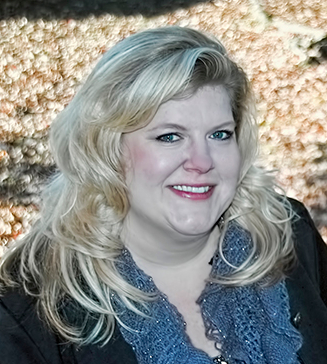
Sherri has said she wants the Birmingham Girls Club Conference to be the city’s biggest feminist celebration. Anyone uncomfortable with the f-word needs to understand how Sherri defines feminism.
“To me, feminism is recognizing, sharing, and growing the qualities that make us powerful women,” Sherri says. “We all have that power, whether we know it or not and whether we choose to use it or not. I know not everyone is keen on the feminist train, but women have worked so hard over the years to prove that we are just as powerful as our counter parts. In Birmingham Girls Club I want to help keep women’s progress going by giving Birmingham women the tools they need to make the mark they want to make, whatever that may be. I think the bond that women form with each other is so special and strong. To be part of a sisterhood like Birmingham Girls Club that’s nothing but strong, intelligent women is a recipe for success.”
The Birmingham Girls Club Conference will be held Saturday, Oct. 19 at REV Birmingham’s Social Venture, 5529 1st Avenue South. Tickets are $99, but See Jane Write Magazine readers can get $20 off by using the code SJW20.
Also, at the conference, See Jane Write Magazine Founding Editor Javacia Harris Bowser will be leading a session on how women can share their stories and why they should. Please leave your questions about writing, blogging, and storytelling in the comments section.
For information on joining the Birmingham Girls Club and to sign up for the Oct. 19 conference, visit birminghamgirlsclub.com.
]]>
When I have kids, they will not be allowed to watch The X-Files until they have watched the entirety of Joss Whedon’s body of work. They will not watch Star Trek Into Darkness until they have been thoroughly indoctrinated, I mean, introduced to the original series.
Call me what you will, but my children will learn first and foremost to be the heroes of their own stories. In The X-Files and Star Trek Into Darkness, female characters are defined first and foremost by their relationships to the men around them. None of their degrees, experiences or qualifications informs how these characters act.
In The X-Files Dana Scully, a medical doctor turned FBI agent, is specifically written to fill certain roles. She is the science-loving skeptic to Mulder’s beliefs for the first six seasons, then later serves as a champion of the paranormal to counter Agent Doggett’s skepticism. She credits Mulder with inspiring her strength to survive cancer. She is the mother to a super-soldier. She is Mulder’s love interest.
Some might argue that Scully is a strong woman within the societal boundaries of the time. However, Buffy The Vampire Slayer started only four years later, and the female characters are completely dissimilar. Despite Buffy’s powder-puff name, she is defined by her choices and struggles with identity, not by her (really, really) dysfunctional relationships with men.
More troubling is how Hollywood hijacked both J. J. Abrams and the women of Star Trek. As one of the strongest woman characters in television history, Uhura has been reduced to the role of Spock’s girlfriend. Carol Marcus, a PhD in applied physics, appears as Admiral Marcus’s daughter – and for a completely gratuitous underwear shot.
It’s certainly not that J. J. Abrams is unfamiliar with creating strong, independent women. As the creator of Felicity from Felicity and Agent Olivia Dunham from Fringe and the director for Zoe Saldana’s Uhura in Star Trek (2009), he is aware.
The next generation of nerds is at stake here. Frankly, the fact that women are still being portrayed as not quite full characters is ridiculous, but nipping this trend in the bud requires that we recognize this trend and fight back.
As geeky as it sounds, the first step to action is to start the discussion. If you see woman characters created for men, by men, speak up. Introducing this concept to your friends and children helps all of us recognize the problem.
After this point, cast your vote with your remote. Your time and energy are two of your greatest assets, and focusing them away from problematic shows brings down the show’s ratings. If the conversation becomes large enough, the character might be resolved by an early cancellation – or a rewrite.
Our voices are our strongest weapons in determining the aspects of pop culture and fandom that endure. It is only when we use them on a regular basis to express our pleasure or distaste that we can make a true change.
Clair McLafferty is the author of our geek girl culture column Talk Nerdy To Me. When she isn’t writing, Clair can usually be found nerding out on programming, cocktails, physics, comics and movies. Some of these interests spill over into her writing at clairmclafferty.com and on to her Twitter feed @see_clair_write.
]]>
Review by Mandy Shunnarah
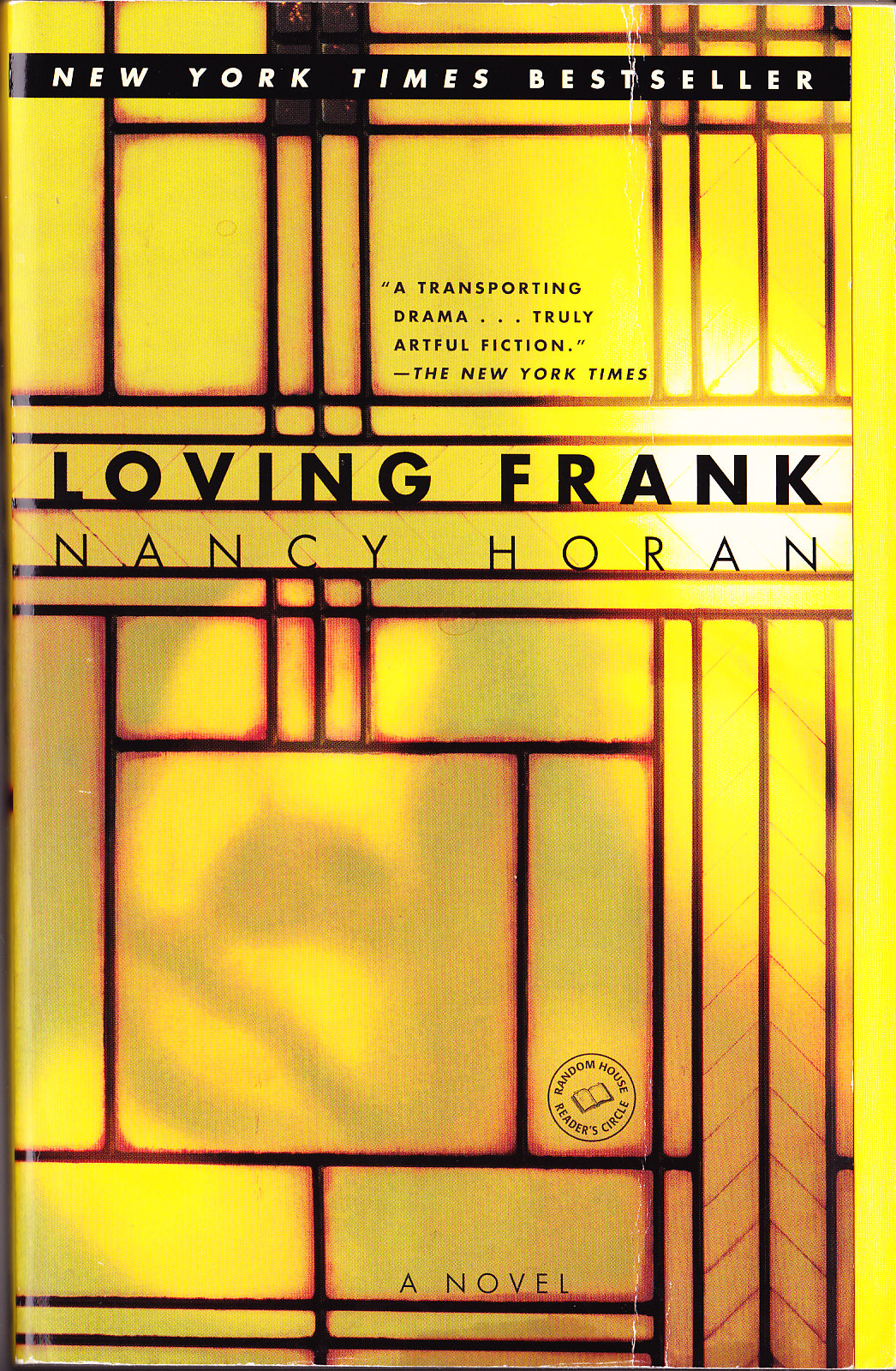
If you’re like me, the idea of reading a historical fiction romance is more than a little gimmicky. It’s the sort of book I’m almost embarrassed to be seen with or admit I’ve read. But there was something about Nancy Horan’s novel Loving Frank that caught my eye, and I thank the book gods it did.
Loving Frank transports the reader to early 20th century Oak Park, Ill. (today a swanky Chicago suburb). Mamah Borthwick Cheney is in a complacent, yet loveless marriage and the irreverent and brazen Frank Lloyd Wright intrigues her. As Frank designs the Cheney’s family home, he and Mamah connect on multiple levels. In 1907, the pair decides to leave their families and start a life together in Europe. Over the course of several countries and 200 pages, the reader enters the couple’s tumultuous, hopeful, and deeply complicated relationship. In a time when women were still thought to be the property of the husbands, Mamah is guilted by her friends and family to return home at the expense of her happiness. This is further complicated by the media’s obsession with Frank’s architectural idiosyncrasies and family abandonment. Then, at the moment when freedom from the media’s blitz and incorporating each of their families into their relationship seems feasible, the sort of “divine retribution” their families and the media predicted occurs–and the hopscotch trail of foreshadowing is so masterfully rendered that you’ll read the chapter again and again.
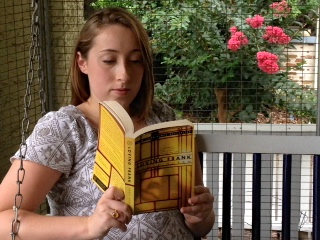
I picked up Loving Frank because I was looking for a summer “beach read,” so I was surprised to find how much I learned from the book. Horan spent years researching Frank Lloyd Wright’s architecture, family, and travels, as well as the little information there was to be gleaned about Mamah Borthwick Cheney, and it shows in her work. Many of the letters and newspaper articles were taken from Wright and Cheney’s archives. Far from reading like a history book, Loving Frank is an exercise in being intimately connected with strangers from the past.

Photo Credit: Mandy Shunnarah
Yet, Loving Frank doesn’t read like your typical steamy page-turner either. You won’t find any erotically descriptive scenes or unwarranted infatuation. Frank and Mamah fall in love for the most authentic and simplest of reasons: they understand each other. Their mutual understanding is spiritual, philosophical, artistic, and, above all, intellectual; it’s an understanding deeper than bodily admiration and the obligations of family. When asked how they can abandon their domestic duties, they answer that they wish to “live honestly.” The pair would rather spend a life together yearning for peace of mind from the public than a quiet life apart yearning for happiness in their failed marriages.

Photo Credit: Mandy Shunnarah
In this unexpected way, I found Loving Frank to be an oddly feminist novel. Mamah exudes the sort of unabashed realist feminism that the fiercely independent singletons often wish to condemn. Because Mamah is steadfast in her course to live honestly, never bending to the will of the society that damns her, I find her to be the accessible type of feminist that is militant and heroic in her own way, commanding respect with her lifestyle. Loving Frank’s plot may hinge upon a romantic relationship, but the protagonist Mamah is made of stronger stuff.

If you’re looking for a book that’s simultaneously surprisingly educational and pleasantly light, add Loving Frank to your shelf.
Do you have a book you’d like See Jane Write Magazine to review? Would you like to write a book review for our website? Send book review pitches to seejanewritemag@gmail.com.
Mandy Shunnarah is a freelance writer and editor, and an aspiring novelist. When she’s not writing, she can be found reading, learning to letterpress, watching Downton Abbey and Game of Thrones, and finding stray cats to cuddle with. Follow her on Twitter at @fixedbaroque and @awhitewrites.
]]>
What would you do if you weren’t afraid?
That’s the question Sheryl Sandberg posed to women in the audience during her keynote talk at last month’s BlogHer ’13 conference in Chicago.
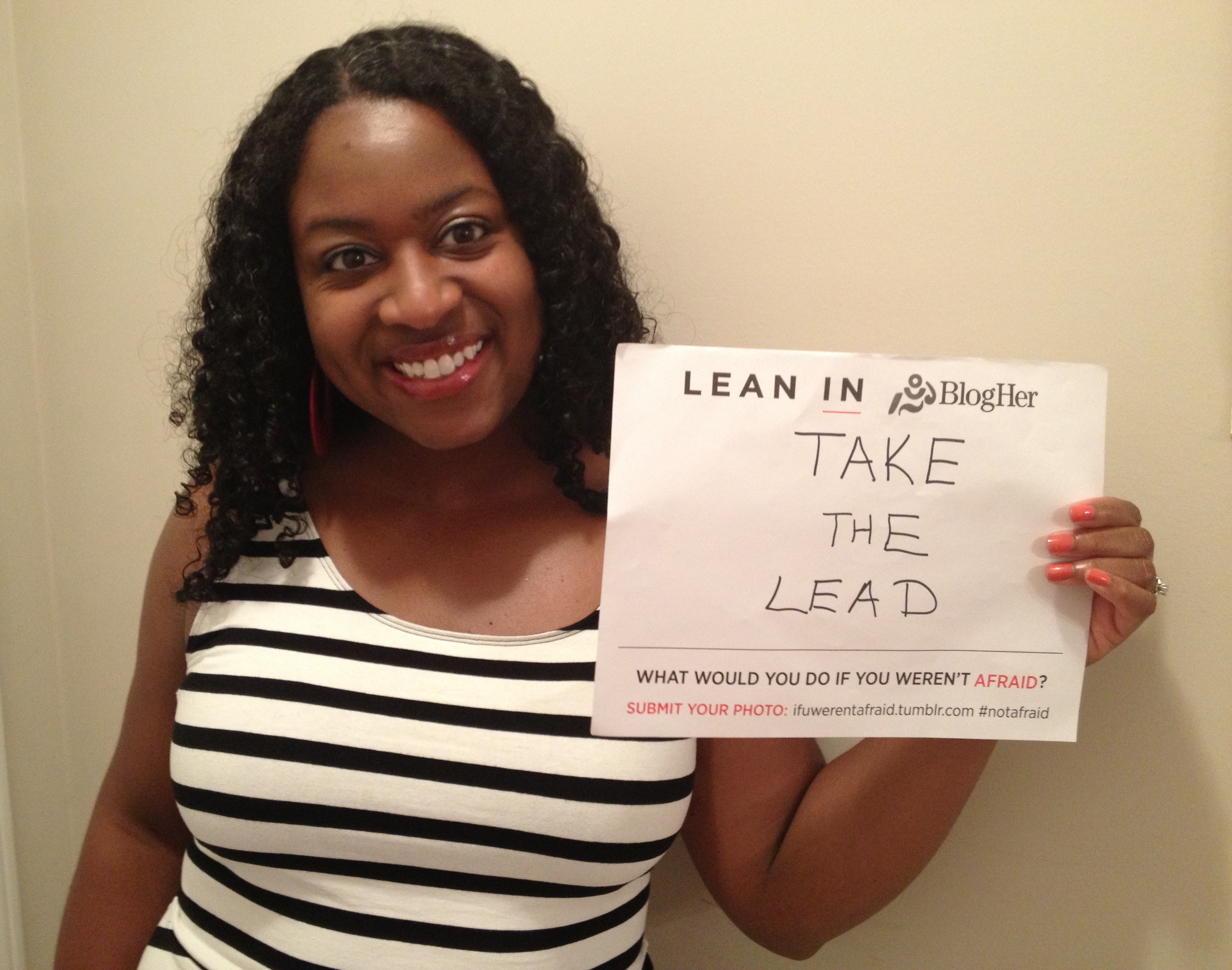
Placed in the center of the tables at which we attendees were seated were sheets of paper with the same question printed at the bottom. Sandberg wanted us to write down our answer, take a picture holding our written declarations and then leave ready to go after our dreams.
Despite the fact that Sheryl Sandberg is the kind of woman that really makes you feel like you can do anything, I just took one of the sheets and slipped it into my bag. I couldn’t figure out what to write!
Last year this time, without a second thought, I would have written: “Start my own magazine.” But on July 1 I conquered that fear and launched this site.
I thought about writing: “Be a feminist blogger.” I spent much of my time at the conference kicking around the idea of re-launching my personal blog as one that focuses solely on feminism instead of one that mostly focuses on the world of writing from a woman’s perspective. But then during her talk, Sandberg said that she wants to be unapologetically a business executive and unapologetically a feminist. And I knew exactly what she meant.
I am a feminist and proud to say so. But I also want to be a well-respected writer; I want to be known as a social entrepreneur who strives to empower women to find their voice and share their stories. I refuse to choose between writer and feminist. I am both and my personal blog should be a reflection of that.

A few days later while thinking about Sandberg’s best-selling book Lean In and the theme for See Jane Write Magazine this month my answer came to me. If I weren’t afraid I would “TAKE THE LEAD.”
Let me explain.
Lean In showed me that most of my life I’ve been acting like a little princess, but not in the way people typically mean when they say that. In her book, Sandberg talks about the “Tiara Syndrome,” a term coined by Carol Frohlinger and Deborah Kolb, founders of Negotiating Women, Inc. The “Tiara Syndrome” is where women “expect that if they keep doing their job well someone will notice them and place a tiara on their head.”
Guilty as charged.
I am a worker bee. Give me a task and I will work on it from dusk to dawn if that’s what it takes to get the job done and get the job done well; and I won’t even ask for overtime pay. This is exactly what I did at my previous newspaper job and I thought all this hard work would automatically lead to the promotion I wanted. When it did not I was devastated, but I had only myself to blame. I didn’t aggressively go after the position I coveted. I thought it would land in my lap, I thought the tiara would be placed on my head simply because of all those long hours. And I was wrong.
As Sandberg writes in her book, “Hard work and results should be recognized by others, but when they aren’t, advocating for oneself becomes necessary.”
And so I am taking the lead. I am drafting a new bucket list, constructing a new vision board and instead of waiting for opportunities to be handed to me, I’m going to create the opportunities I desire. Instead of waiting for my metaphorical prince to choose me, I choose myself. I will aggressively go after every goal and I will not apologize for my ambition.
In August many of our articles will celebrate women who are taking the lead in their careers and in their communities.
My hope is that their stories will inspire you do to the same.
And it’s OK if you’re afraid. Being courageous is about feeling the fear and pressing on in spite of it.
What would you do if you weren’t afraid?
]]>